- What it is
- Gartner's August forecast for AI-optimized infrastructure-as-a-service: cloud capacity built specifically for AI.
- The numbers
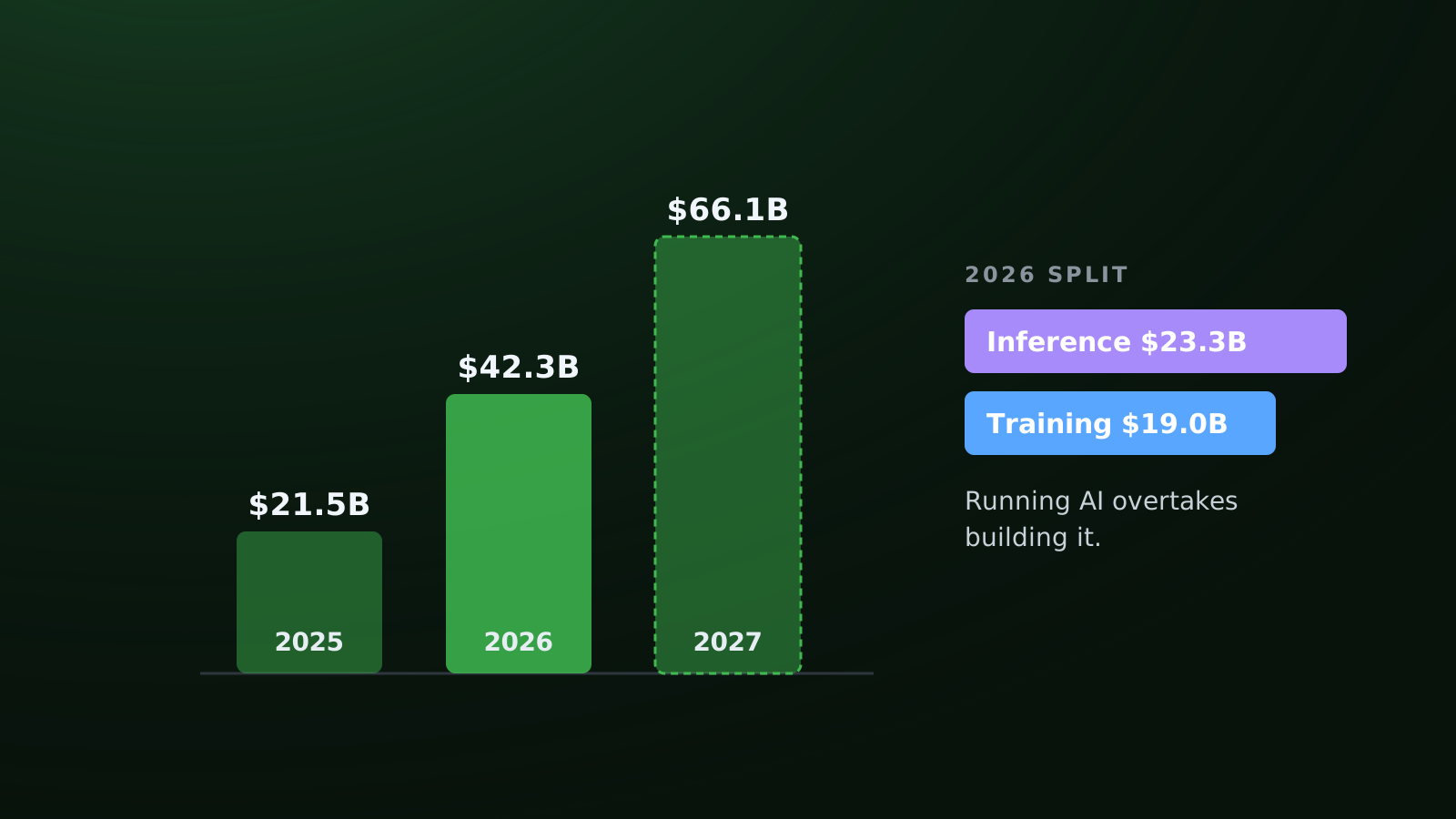
- $42.3B in 2026, up 96%, rising to $66.1B in 2027. In 2026, inference ($23.3B) overtakes training ($19B).
- Why it matters
- Training is a project with an end. Inference is a running cost that grows with every user and every agent.
- Caveat
- These are forecasts, not results.
The forecast
In August, Gartner forecast that worldwide spending on AI-optimized infrastructure-as-a-service would grow 96% in 2026, to about $42.3 billion, and reach about $66.1 billion in 2027. Total cloud infrastructure spending, by comparison, grows about 29% in 2026 to $287.3 billion.
The more telling detail is the split. In 2026, Gartner expects inference — running trained models to answer questions and do work — to account for $23.3 billion, overtaking training at $19 billion. Inference reaches 55% of the category this year and 59% in 2027.
"This shift is accelerating the cloud consumption patterns and creating sustained demand for AI-optimised infrastructure." — Hardeep Singh, Sr Principal Research Analyst, Gartner
The meter that doesn't stop
Training a model is expensive, but it ends. Inference is paid every time the model is used — every chat, every document summarized, every step an agent takes. As AI moves from demos into daily work, that running cost becomes the bigger line on the bill.
It is also why the efficiency claims in this month's open-model releases matter. Mistral, for example, says Large 4 matches a rival "while using 47 percent fewer tokens per task" — a claim about inference cost, not intelligence.
The bigger number
In September, Gartner raised its forecast for total worldwide AI spending in 2026 to about $2.67 trillion, up 49.5% on 2025. Infrastructure makes up about $1.48 trillion of that.
"The buildout of AI data center capacity is the largest infrastructure project humanity has ever undertaken." — John-David Lovelock, Gartner
Sources
- AI IaaS Spending to Surge 96% in 2026, Gartner Says — DIGIT · Aug 12, 2026
- Gartner: Global AI Spending to Hit $2.7 Trillion in 2026 — Techstrong.ai · Sep 21, 2026
- Gartner press release (Aug 10, 2026) — Gartner — figures above cross-checked via DIGIT
- Published.