- What happened
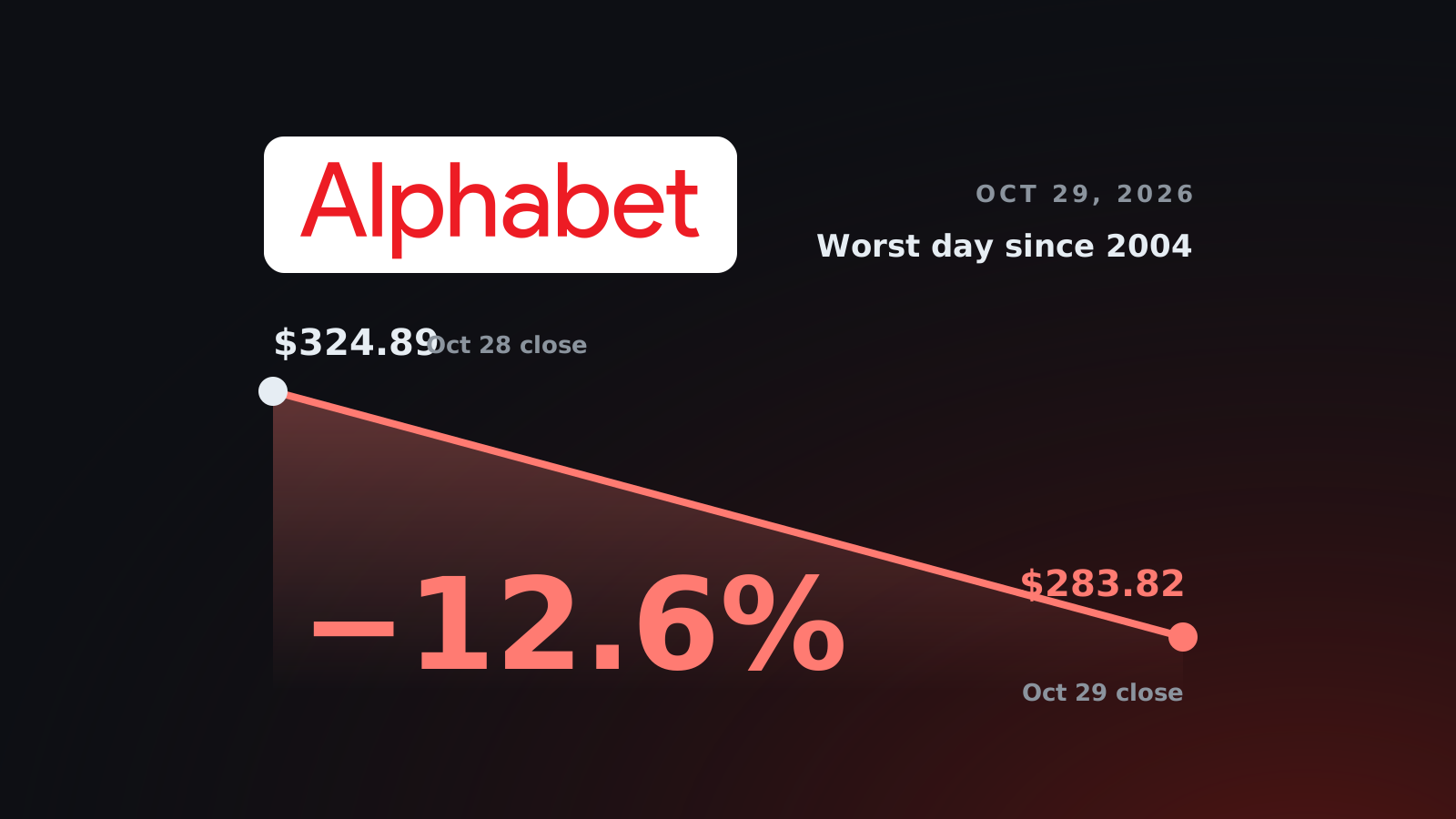
- Alphabet's shares fell 12.6% on October 29, the day after its third-quarter results — the biggest one-day drop since it went public in 2004.
- The numbers
- Revenue up 25% to $127.6B and Google Cloud up 103%, but capital spending of $51.4B outran $42.3B of operating cash: free cash flow was minus $9.1B.
- Why it matters
- It is the first time the market has punished an AI leader for how much it spends, rather than for falling behind.
- Caveat
- One bad day is not a verdict. Alphabet kept its spending plan, and the cloud business it is building for is growing fast.
The day
Alphabet reported its third-quarter results after the market closed on Wednesday, October 28. On Thursday its Class A shares closed at $283.82, down 12.64% from $324.89. That is the stock's worst day since Google went public in 2004, beating the 11.63% drop of March 2020.
Estimates of the market value lost range from about $475 billion to about $500 billion, depending on when it was measured. Either way, only one company has lost more in a single day: Nvidia, which shed nearly $600 billion in January 2025.
The quarter was not bad
That is what makes the reaction worth reading closely. By most measures, Alphabet's quarter was strong:
- Revenue: up 25% to $127.6 billion.
- Google Cloud: up 103% to $30.7 billion, with operating income of $11.1 billion. Alphabet says sales of its TPU systems — its own AI chips — were "a meaningful contributor."
- Operating income: up 30% to $40.6 billion, a 31.8% margin.
"Google Cloud revenues grew 103%, powered by huge demand for our AI infrastructure and AI solutions." — Sundar Pichai, CEO, Alphabet
Pichai also said the Gemini app has reached one billion users, and that Google's own model APIs now process nearly 32 billion tokens a minute, more than four times as many as a year ago.
Where the cash went
The problem was the other side of the ledger. Alphabet spent $51.4 billion on property and equipment in the quarter — mostly data centres, servers and chips — more than double the $24.0 billion of a year earlier. Its operations brought in $42.3 billion in cash.
The difference is free cash flow: minus $9.1 billion. A year earlier it was plus $24.5 billion. It is the second negative quarter in a row, after minus $5.9 billion in the second quarter, and only the second time that has happened since Google went public.
The release shows how the gap was filled. In the quarter Alphabet raised $28.7 billion in new bonds, sold $12.4 billion of its own stock through an at-the-market programme, and bought back none — against $11.5 billion of buybacks a year earlier. According to CNBC, it held its full-year spending guidance at $195 billion to $205 billion.
Earnings per share were $2.12, against about $3.01 expected. Part of that is not operational: an $8.7 billion loss on the value of equity investments Alphabet holds, which the release says cut earnings per share by $0.55.
The search question
Investors had a second worry. Search revenue grew 12% to $63.4 billion — Alphabet says search queries grew at their fastest rate in five years, but revenue growth slowed from 17% in the second quarter, and missed analysts' estimates.
On the earnings call, according to Implicator, chief business officer Philipp Schindler said queries in AI Mode — Google's chatbot-style search — were replacing some traditional searches, with lower ad revenue per query. Google is adding ads to AI Mode answers. Until those earn as much as the links they replace, every search that moves to AI is worth a little less.
"One of the companies most aggressively investing in AI to protect its core businesses showed vulnerability to AI." — Mike O'Rourke, JonesTrading
Microsoft, the same day
Microsoft reported the same evening and got the opposite reaction. It trimmed its full-year spending forecast to $170 billion from $175 billion — CFO Amy Hood said outside GPU suppliers had delays that push some capacity into the first half of 2027 — and still produced $18.6 billion of free cash flow. Its Azure cloud grew 48%. Its shares ended Thursday down 0.2%.
Both companies are spending at a historic rate. The difference investors drew was whether the cash coming in still covers it.
What to watch
- The fourth quarter. Alphabet has spent $132 billion on property and equipment so far this year. The top of its $195–205 billion guidance implies as much as $73 billion in the last three months alone.
- Ads in AI Mode. Whether answers with ads earn what the old results pages did is the number that decides whether AI protects Google's core business or eats it.
- Cloud demand. The capacity being built is meant to be sold. Cloud's 103% growth is the strongest argument that it will be — and the one investors will check first next quarter.
Analysts at NewStreet Research, quoted by Implicator, expect the doubts to last until Alphabet can restore "faith in search fundamentals and AI monetization" — possibly into the first half of 2027.
What it means
For three years, the main risk the market priced into AI companies was falling behind. October 29 is the clearest sign yet that the question has changed to whether the spending pays for itself — and when.
"Markets are carefully calibrating the trade-off between capex and free cash flow." — Dec Mullarkey, SLC Management
It is one day, and Alphabet did not blink: it kept its spending plan, and its cloud business — the part selling that capacity to others — more than doubled. But it puts a number on a question every AI provider now faces, including the ones whose models run in Google's data centres: the bill for the buildout is due before the revenue arrives.
Sources
- Alphabet Announces Third Quarter 2026 Results (Form 8-K, Exhibit 99.1) — Alphabet via SEC EDGAR · Oct 28, 2026
- Alphabet Inc. logo (2015) — Wikimedia Commons · public domain
- AI buildout hits snag as Google and Microsoft put off raising capex forecasts — CNBC · Oct 29, 2026
- Stock market today: Alphabet stock sinks 12% and AI jitters return — Yahoo Finance · Oct 29, 2026
- Alphabet loses $475 billion in market value, the biggest drop in its history — Yahoo Finance · Oct 29, 2026
- Alphabet Loses $500 Billion as AI Spending Pushes Cash Flow — Implicator · Oct 30, 2026
- Published.