
The short versionResearch
- What it is
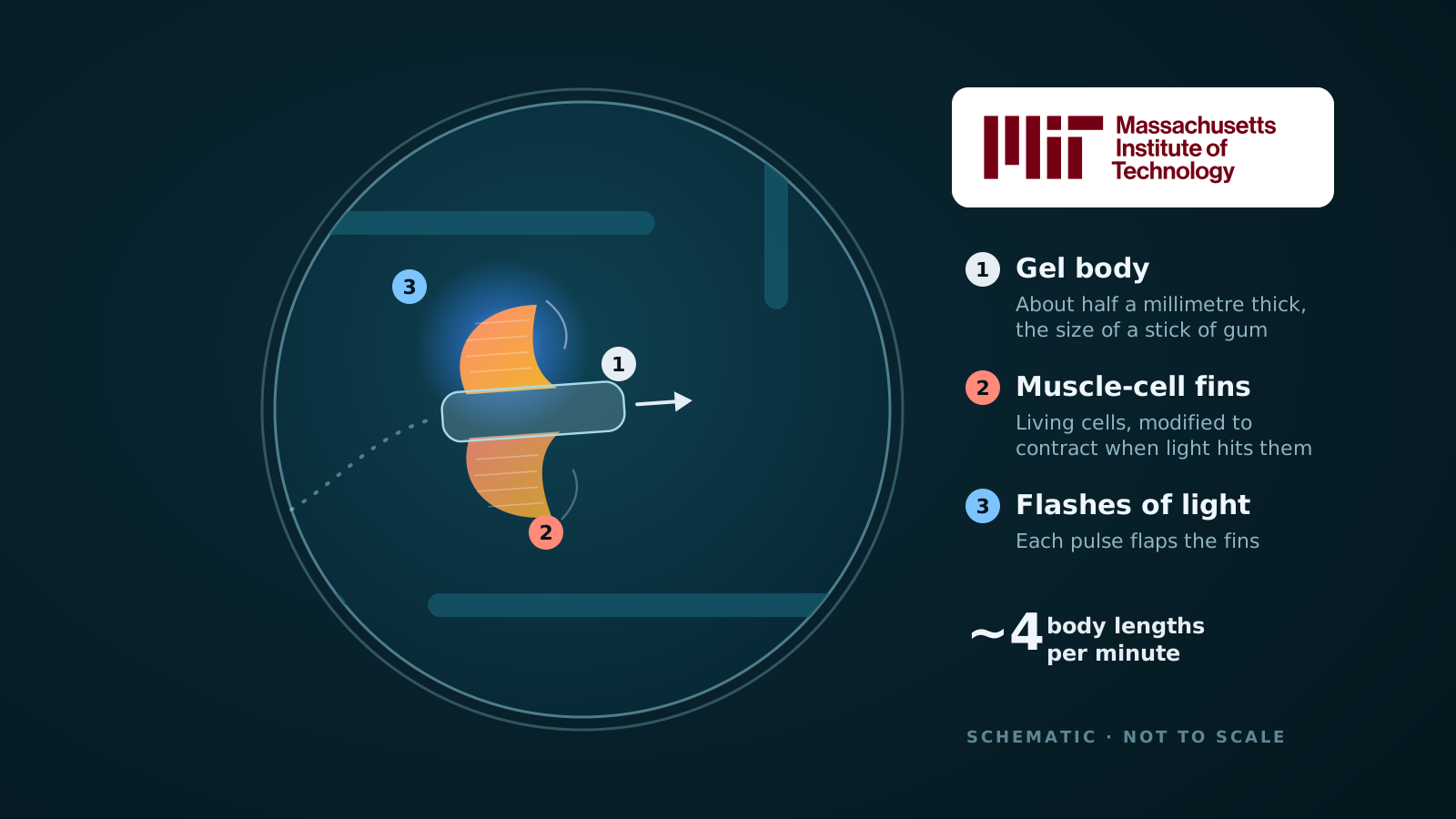
- A gel framework with two fins coated in genetically modified muscle cells that contract when light hits them.
- The result
- It swims at up to about four body lengths per minute.
- Why it matters
- The paper reports that thin muscle films make biohybrid robots more efficient — a step for a field that builds machines from living tissue.
- How far along
- ResearchPrototypePilotShippingEverywhereResearch. A lab prototype; practical uses are some way off.
What they built
MIT engineers built a robot from a gel called GelMA, roughly the size of a stick of gum and about half a millimeter thick. Its two fins are coated with muscle cells genetically modified to respond to light, so researchers can make them contract — and the robot swim — by shining light on them.
It reaches about four body lengths per minute. MIT describes it as the first thin, two-dimensional robot to move from place to place using living muscle tissue.
"It takes a lot of force to move through water versus air." — Ritu Raman, MIT
Why thin matters
The paper's title makes the point: "2D Skeletal Muscle Thin Film Actuators Enhance Efficiency of Biohybrid Robots."
Uses such as machines that heal themselves have been suggested, but they are forward-looking ideas, not results. The research was partly funded by the US Office of Naval Research.
Sources
- Powered by muscle cells, a paper-thin robot swims through watery maze — MIT News · Sep 29, 2026
- MIT scientists build a tiny robot that swims using living muscle cells — ScienceDaily, republishing MIT · Oct 23, 2026
- 2D Skeletal Muscle Thin Film Actuators Enhance Efficiency of Biohybrid Robots — Advanced Functional Materials, 2026 — Bawa, … Raman
- MIT logo and wordmark (2023) — Wikimedia Commons · public domain
Update log
- Published.
- New illustration with the MIT logo: the robot in a maze, with what each part does.